Categorically Incorrect: Ethical Fallacies in Canada's War on Terror by A. Alan Borovoy
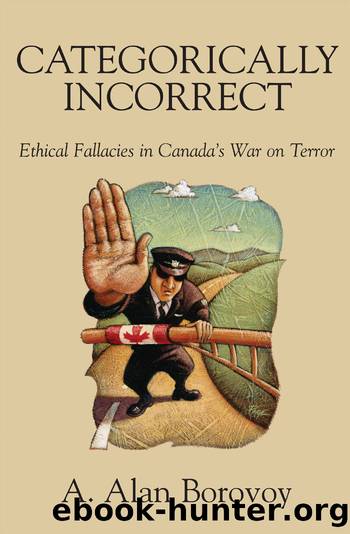
Author:A. Alan Borovoy [Borovoy, A. Alan]
Language: eng
Format: epub
Tags: Democracy, Political Ideologies, Comparative Politics, Political Science, General
ISBN: 9781459718517
Google: EKpUzVD6yMQC
Goodreads: 17353810
Publisher: Dundurn
Published: 2008-07-03T00:00:00+00:00
MORE ANTI-HATE MEASURES
The governmentâs anti-terrorist legislation contains a feature that could well appeal to certain groups with rather disparate interests: on the one hand, Jews and Israelis; on the other hand, Arabs and Muslims. Pointing out that âdiscrimination against persons of any religious or racial or ethnic background will not be tolerated,â then justice minister Anne McLellan told her fellow parliamentarians that the anti-terror bill provides for the deletion of hate material âfrom computer systems such as an Internet site.â45 This provision could well have been designed to address some of the anxiety that Arabs and Muslims were experiencing in the aftermath of 9/11. It certainly accorded with a long-standing proposal by the Canadian Jewish Congress.
Too bad. Despite this measureâs apparent popularity with both of these minority constituencies, the government should not have adopted it. Instead of moving to increase Canadaâs anti-hate measures, the government should have started to reduce them.
The problem with these provisions is their ability to threaten legitimate freedom of speech. Even though this freedom is not an absolute, it nevertheless engages the guts of the democratic system. It enables any of us to appeal for public support in our efforts to redress our grievances. As indicated earlier, freedom of speech is based on the experience that injustice is less likely to endure, or even to emerge, in an atmosphere of open public debate.
The special problem with the anti-hate law is the unavoidable vagueness of the word hatred. It would have been more acceptable for the law to address incitements to violence. But hatred can create a legal morass. We know that freedom of speech is often most important when it expresses strong disapproval. But where does strong disapproval end and hatred begin? The risk, therefore, is that this law could wind up targeting expression that doesnât bear the slightest resemblance to the invective of hate mongers. Indeed, this has already happened. Among those harassed by Canadaâs thirty-year-old anti-hate law are anti-American protesters, French Canadian nationalists, anti-apartheid activists, a pro-Zionist book, and a Jewish community leader.46
Significantly, some of the formulations in the anti-terror bill did not satisfy the Canadian Jewish Congress. It complained that one of the powers was too narrow; it would be âlimited to hatred.â âRather,â the congress argued, the âpower should include âboth hatred and contemptâ [emphasis added].â47 For the Canadian Jewish Congress, therefore, the idea is to expand the power to encroach on free speech. Indeed, the power proposed by the congress would delete from the Internet and certain other places, material âthat is likely to expose ⦠persons to hatred or contemptâ on grounds such as race, religion, and ethnicity.48
If enacted, such measures might well not require a âwilfulâ intent as the general anti-hate law does. Similarly, they might not provide a defence for truth or reasonable belief in the truth of the statements at issue. On this basis, truthful discussions of racial, religious, and ethnic warfare in Bosnia, Rwanda, or Northern Ireland could very well run afoul of such an enactment.
Download
This site does not store any files on its server. We only index and link to content provided by other sites. Please contact the content providers to delete copyright contents if any and email us, we'll remove relevant links or contents immediately.
| Anthropology | Archaeology |
| Philosophy | Politics & Government |
| Social Sciences | Sociology |
| Women's Studies |
The Secret History by Donna Tartt(19092)
The Social Justice Warrior Handbook by Lisa De Pasquale(12190)
Thirteen Reasons Why by Jay Asher(8912)
This Is How You Lose Her by Junot Diaz(6888)
Weapons of Math Destruction by Cathy O'Neil(6281)
Zero to One by Peter Thiel(5802)
Beartown by Fredrik Backman(5756)
The Myth of the Strong Leader by Archie Brown(5509)
The Fire Next Time by James Baldwin(5447)
How Democracies Die by Steven Levitsky & Daniel Ziblatt(5219)
Promise Me, Dad by Joe Biden(5154)
Stone's Rules by Roger Stone(5088)
A Higher Loyalty: Truth, Lies, and Leadership by James Comey(4964)
100 Deadly Skills by Clint Emerson(4926)
Rise and Kill First by Ronen Bergman(4790)
Secrecy World by Jake Bernstein(4753)
The David Icke Guide to the Global Conspiracy (and how to end it) by David Icke(4720)
The Farm by Tom Rob Smith(4514)
The Doomsday Machine by Daniel Ellsberg(4490)
